
The Big Fight 2007: Series 40 vs S60
When Symbian devices first started appearing, the difference between a smartphone and a normal phone was very clear indeed. Smartphones had distinctive features such as large colour screens, memory card slots for mass storage, music players, the ability to run advanced applications such as true 3D games. They were also generally bigger than normal phones, far more expensive, had much slower menus and were much more prone to system crashes.
However, with advanced features appearing in normal phones and increased stability in smartphones, it seems that the gap may be narrowing. To examine just how narrow this gap now is, we'll look the most popular type of smartphone, Symbian OS-based S60, and the most popular type of normal phone, Nokia Series 40.
As examples of these two types we have the Nokia 5700 and Nokia 5300, two very similar-looking phones, made by the same company, aimed at a similar audience and marketed in a similar way, both part of the XpressMusic sub-brand, both running the latest versions of their respective operating systems.
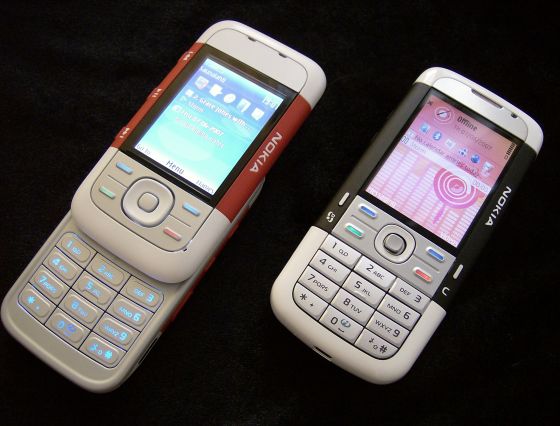
The 5300 normal phone runs Series 40 3rd Edition Feature Pack 2, the latest version of Series 40.
In the, er, Black Corner: Nokia 5700
The 5700 smartphone runs Symbian S60 3rd Edition Feature Pack 1, the latest version of S60 running on top of the latest version of the Symbian operating system.
Round 1: The Weigh-in
The 5300 is 107g, while the 5700 is just a touch heavier at 115g. This is an absolutely tiny difference, and indeed if you look more widely the latest S60 and Series 40 phones all tend to come in at around the 100g mark. There are some very light S60 models, the upcoming 6120 Classic weighs just 89g, and there are some very heavy Series 40 models, the upcoming 6500 Slide is 123g (which is 3g more than the N95 incidentally).Clearly weight is no longer a significant difference between S60 and Series 40. This makes a lot of sense, as Symbian and S60 has moved towards a new production process involving fewer microchips, so Symbian S60 smartphones can be much smaller than they were in the past. At the same time, Series 40 phones are starting to adopt advanced features like 3 megapixel cameras and videophone calling, which require the same extra hardware that similarly-featured S60 phones already carry, so the difference in weight is even more likely to disappear.
Verdict: A draw, the 5300 and 5700 are virtually the same weight.
Round 2: Nurse, the Screens (and the Interface)
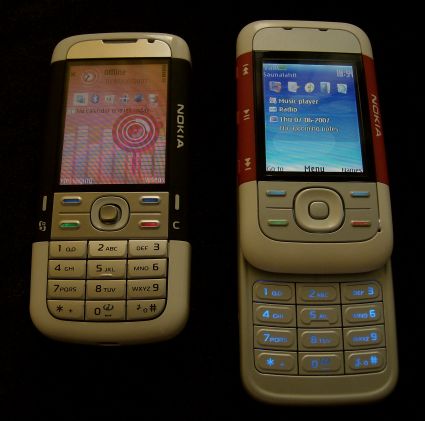 The Nokia 5700 has a QVGA 240x320 screen... and so does the Nokia 5300. The old bastion of smartphones, the high resolution display, has now fallen, and thanks to Series 40's adoption of S60-style icons it's actually quite difficult for the average person to tell an S60 3rd Edition menu from a Series 40 3rd Edition menu.
Series 40 has also started using its own form of active standby screen, which is functionally very similar to the one introduced in S60 3rd Edition. It's not as slick, the animation when you choose an icon in Series 40 is rather poor, but it works and it's one more significant difference chipped away.
When you delve a little deeper into Series 40 3rd FP2, you find that everything is slightly larger than on S60, which gives it a somewhat less sophisticated appearance but also makes it easier to read.
The speed with which you could navigate through the menus was a problem on S60 when it launched, and continued to be noticeably slower than Series 40 for many years. However, S60 3rd Edition devices have significantly faster processors and a more streamlined interface than previous models, and the 5700's menu speed is pretty much the same as the 5300's menu speed.
The 5700's S60 interface does have one huge advantage over the 5300's Series 40 interface: thanks to S60 3rd FP1, you can now customise the menu structure completely to your own liking, creating as many folders and sub-folders as you want and moving any icon into any folder or sub-folder. This gives you enormous flexibility over how the features of the phone are accessed, and, if you're willing to put the work in, lets you mould your S60 device into something approaching your perfect phone.
Verdict: The 5700 wins largely through FP1's sheer flexibility, although the latest Series 40 interface is clearly catching up fast with S60.

Round 3: Stability
The more complicated something is, the more things can go wrong with it. Jets require far less maintenance than propeller aircraft because the jet engine is a far simpler design than the piston engine. Series 40 phones aren't multitasking, and the Series 40 operating system is much less ambitious than Symbian S60. As an almost inevitable consequence, S60 phones (and indeed all smartphones) are much more likely to crash than normal types of phone like Series 40.This instability has greatly decreased as S60 and Symbian have matured, and the latest version (S60 3rd Edition) is generally considered extremely stable. This reviewer has used the Nokia E61 for a year and the 6290 for many weeks, and neither has ever crashed. However, some models still seem to have problems: the 5700, which also runs S60 3rd Edition, crashed several times within the two weeks that this reviewer had access to it.
Verdict: The 5300 wins, but more narrowly than it would have done a couple of years ago. The 5700 does show instability, but it's still relatively rare compared to the bad old days of S60, and looking at S60 3rd Edition as a whole there are models that don't seem to crash at all.
Round 4: The Essentials: Calls, Texts, Calendars, Alarms and Notes
Making and receiving calls on the 5300 and 5700 is a virtually identical process, with virtually identical address book and call log applications. The Series 40 Contacts app now lets you add fifteen different types of field to each entry.
Text messaging too has become very similar on S60 and Series 40. Indeed the 5300 arguably has a better SMS application, with slick new features such as letting you add the recipient from a list of recently used names, and converting text smileys into real smileys. Neither of these are present on any S60 phones.
The Series 40 Calendar application on the 5300 is, for most people's purposes, more or less the same as the S60 Calendar application on the 5700. The same selection of views is available, but as with SMS the latest version of Series 40 is arguably better than S60 in some ways: it devotes the entire bottom third of the screen to displaying the selected day's schedule, instead of just the small pop-up that appears on S60.
The S60 3rd FP1 Clock application found on the 5700 is a nose ahead of the 5300's Alarm Clock, largely due to the new FP1 Clock's support for multiple alarms, although Series 40 allows a single alarm to be repeated on a user-selected series of days (for example Monday to Friday).
The 5300 includes a Notes application similar to the one on S60, although the Series 40 version has a limit of 3000 characters per note.
Verdict: The 5700 wins as it has slightly more options in these "essential" applications, although the 5300 gives it a run for its money with one or two nice features that just aren't present in the S60 versions.

Round 5: Browsing the Web
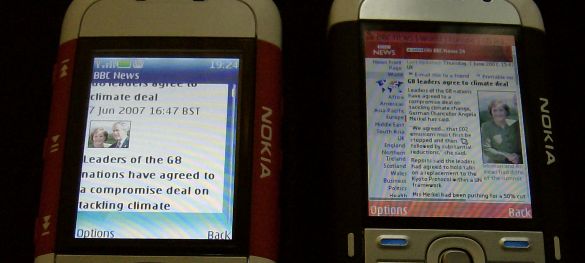
Here's where S60 pulls way ahead of Series 40: with a S60 phone you can browse most web sites pretty much as they would appear on a PC screen, including sites that use Javascript and Flash, and you can even open multiple windows. Series 40 phones can only browse very simple HTML sites or WAP sites which are largely or entirely text-based.
Verdict: The 5700 wins by a huge margin. As a layperson might say, it's "the real internet". This is one of the major reasons why you'd buy an S60 phone.
Round 6: Third Party Applications & Games
 The very latest Java applications and compatible phones are far more sophisticated than they used to be. On a high resolution Java-compatible phone you can have fast real 3D games for example.
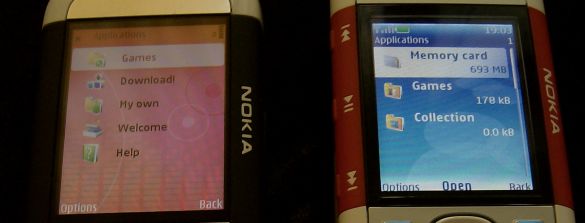
However, S60 phones not only have much faster processors and more RAM than Series 40 ones, they also have the ability to run S60 applications. S60 apps can access the powerful S60 hardware far more directly, efficiently and comprehensively than Java apps, which means faster, better, more flexible applications. S60 games like Snakes (see the picture opposite) can be small, smooth and fast because they're written to use the S60 hardware fully instead of trudging through the mud that is the J2ME Java platform.
S60 phones also have a huge trump card over Series 40: they're multi-tasking. As long as you have enough RAM, you can use several applications at once and switch between them at any time just by holding down the menu key. Series 40 phones have to close the currently running application before they can start another app. There are some functions of Series 40 which can carry on in the background, such as the music player, radio and alarm clock, but on the whole Series 40 forces you to do one thing at a time with your phone.
Verdict: The 5700 again brings home the bacon, it really is a pocket-sized computer, and well-written S60 applications run rings around anything that Java can do. And as S60 phones can use Java apps too, Series 40 has absolutely no advantage over S60 when it comes to third party applications.
Round 7: Multimedia
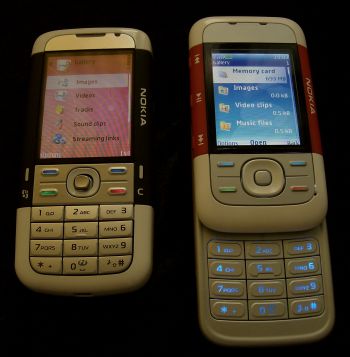 Thanks to its beefier hardware, S60 phones have always been excellent platforms for music and video playback. By contrast, Series 40 has always lagged behind S60 in terms of the quality and quantity of multimedia files that it can play. However, this is changing.
Mass storage memory cards used to be something you only found on smartphones, but now you'll find them even on lower-end normal phones. The 5300 uses 2 gigabyte microSD cards, and so does the 5700.
Bluetooth stereo headphones using the new A2DP standard are cutting edge, but they're also yet another feature which is now available on Series 40 as well as S60. The 5300 and 5700 are both A2DP compatible, and they're also both AVRCP compatible (AVRCP lets you control multimedia playback wirelessly via Bluetooth, for example through music controls built into headphones).
Because S60 hardware will always be more powerful than rival Series 40 hardware, in theory S60 will always be a better platform for multimedia. However, there are limits on what people in the real world actually need from multimedia. No one wants better-than-CD-quality sound for example, which is why all physical CD replacements have failed to win any sigificant market share. At some point the sound quality on all multimedia phones will be good enough for the vast majority of people, and it will become pointless to try to improve it.
As far as music playback is concerned, Series 40 models like the Nokia 5300 are very good, and the average person probably wouldn't be able to hear much difference between a track played back on a Series 40 phone and on a S60 phone if they listen through the same headphones. There are still significant differences in the way the phones handle playback, for example the 5300 tends to stumble a bit when changing tracks during playback whereas the 5700 copes without any problems. However, these differences are relatively subtle.
Video playback shows a much more significant gap between Series 40 and S60. The 5300 can do fairly good video at 320x240 but it's still pretty grainy and there are plenty of artefacts that scream "this is a phone video". The 5700 by contrast has excellent QVGA-sized video playback, and when it's in use it looks pretty much like a pocket-sized television.
Verdict: The 5700 wins, but only just. While audiophiles will appreciate its superior sound quality, the actual difference between Series 40 and S60 music playback is much smaller than it used to be and will one day disappear altogether. The 5700's big trump card is its wonderful video playback, far better than the 5300's. Other advanced features like memory card capacity and A2DP compatibility are identical on the 5300 and 5700.

Round 8: Battery Life
As one of the official Nokia bloggers recently noted, smartphones and portable devices in general are running into a serious problem: mobile technology is developing exponentially, but battery technology is only developing linearly. In other words, phone manufacturers are coming up with new and better ways to use portable devices far far faster than battery manufacturers are coming up with new and better forms of energy storage.
While a budget no-frills phone can be used for a week or even more between charges, the latest smartphones can require recharging every day if you use its advanced features regularly.
Series 40 phones have traditionally required far less charging than S60 phones, but this has been largely due to their comparative lack of features: people didn't listen to MP3s on Series 40 phones, they didn't watch videos, and the phones themselves didn't have large screens.
S60 is likely to lose any battery life comparison with Series 40, largely because S60 phones have far more things to spend their battery life on. The HTML S60 web browser for example, or the DVD-quality camera on the N93 both eat up battery life more quickly than their far more primitive counterparts on Series 40 phones.
Verdict: 5300 wins, but largely because it does much less than the 5700.
Round 9: Price
S60 smartphones used to be extremely expensive, and consequently they were usually only bought by people who really wanted a smartphone. That's now changing, partly thanks to those new production processes that allow Symbian phones to be made with fewer chips, and the recently announced Nokia 6120 will launch for 260 euros sim-free (plus taxes). At this price range, S60 phones are now deep within the territory previously occupied by Series 40 models, for example the Nokia 5300's launch price was the same as the 6120's.However, this is all in the future, and at present Series 40 phones are still extremely cheap compared to their S60 equivalents. The 5300 is currently available for about 160 euros sim-free (plus taxes), while the 5700 has launched for about 310 euros sim-free (plus taxes).
Whether a Series 40 phone is better value than a similar S60 model depends on what you want to do with the phone. If you want to browse the web or watch video or multitask, S60 provides these in a way that Series 40 simply cannot. If you just want to listen to music and handle your calls, texts and appointments in a sophisticated way and on a relatively large screen, Series 40 might just be good enough to challenge S60.
Verdict: The 5300 "wins" in that it costs half the price of the 5700, but in the real world people look for value rather than just price. You get what you pay for.
Overall:
No device is perfect, there's always a catch to do with price, features, size or battery life. Whatever you choose, you will pay for your choice in some way.
Using the 5300 and 5700 it does seem obvious that Series 40 is catching up with S60 in terms of features and screen size, while S60 is catching up with Series 40 in terms of price, stability and phone size. They're seemingly on a collision course.
Will they merge? Will we one day see S60 replacing Series 40? If the launch prices of S60 models continue to fall and S60 continues to get more stable, it does seem possible, but the one big stumbling block is still the battery life. In order to use the features that make S60 phones worth having, you have to dip deeply into these phones' energy supplies.
What a modern smartphone needs in order to become truly mainstream isn't a faster processor or a larger amount of RAM, but quite simply a better battery.
Krisse, AllAboutSymbian, 8 June 2007