All About Symbian - News from the Symbian Ecosystem...
Nokia Maps get Lonely Planet content
Published by Rafe Blandford at 12:21 UTC, August 19th 2008
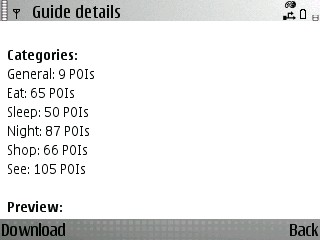
Content from the Lonely Planet travel guide series is now available in Nokia Maps. The guides are available via the Extras section in the Options menu of Nokia Maps 2.0. The Lonely Planet guides take the form of a collection POIs (Points of Information) which are divided into several categories (Eat, General, Night, See, Shop and Sleep). Read on for more details and screenshots.
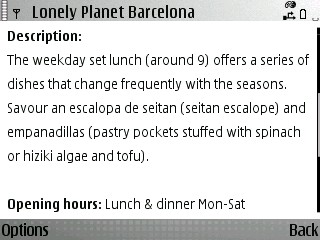
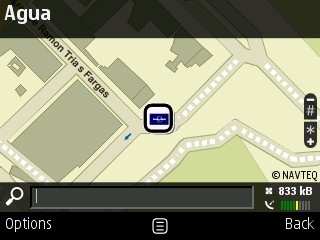
The POIs generally have significantly more extra information than the default POIs (usually just an address and phone number). POIs in the guide have a description, details of the nearest public transport and, where relevant, opening times. As with other POIs in Nokia Maps you can view details, navigate to it (car or walk), send it to a friend or save it as a favourite.
As such the travel guides contain only a sub-set of the information available in the book versions of the guide. I think the Nokia Maps team would do well to find a way to include more of the generic information that is found in book versions of the guides (perhaps via the Web browser?). The guides would also benefit from the greater use of multimedia - be images, video or audio. Equally additionally features such as self guided tours (routes) could be included to add extra value.
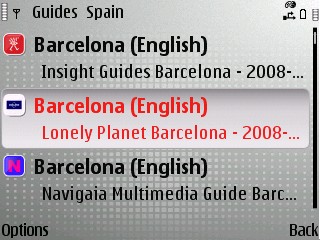
The guides cost £5.99 which seems relatively expensive given you're only getting a subset of information from the paper version. Fortunately a 10 minute trial (something new in Nokia Maps) is available which gives you an opportunity to try before you buy. I do think that it represents good value for the traveller looking for immediate information (e.g. business travellers in town for a few days). It is difficult to deny the benefit of the immediate over-the-air guide experience.
The quality of the Lonely Planet guide I tried was very good. 382 POIs added a great level of detail to what was already available and covered all the major tourist attractions and a reasonable number of restaurants and guides. The value is not so much in the locations (most POIs were already covered), but in the extra detailed information that comes with them. Information such as restaurant type and opening times are essential for the traveller.
This contrast with other guides available via Nokia Maps in which the quality varies greatly. I would like to see some way of rating and ranking the guides, especially as many cities have multiple options (Lonely Planet, AA, Berlitz etc.).
Here's a quick video run through showing the Lonely Planet Guide for Barcelona in Nokia Maps:
"Lonely Planet is a well known brand amongst travellers and stands for adventure and editorial independence," said Maximilian Schierstadt, head of media partnerships, Nokia context based services. "We are very excited to offer their expert local recommendations and itineraries to our Nokia Maps consumers, which will allow Nokia to continue to innovate and enable compelling location aware experiences."
Stephen Palmer, CEO, Lonely Planet Publications added, "This is a genuinely transformational deal, which makes Lonely Planet content readily available regardless of time or place. It will help all those questions which travellers frequently have on the road such as 'What should I explore today' or 'where should I go for dinner tonight?' Together with Nokia we will help more travellers connect profoundly with their world, every day."
Lonely planets will not do justice to me if I purchase it..they anyways have not covered India that much to give me enough POIs...
And no intentions to travel to europe in near future
snoyt
I found not all paper lonely planet guides that good. Some where distinctly better than others. For Scotland I found the 'rough guide ' much better i.e (Forgot the publisher/writer). The 10 minutes try-out seems a good idea. In a paperguide is that you can see what kind of information and quality of information you get. A typical interest is POI's categorized by price ranges and quality for eating and sleeping. I am looking forward to a more in-depth review on the guides.
Get a bunch of licenses for all the guides and evaluate each with a local person? Time for a new website? All About Nokia Map Guides?
Rafe
snoyt - I'll try do a real world use review next time I'm somewhere appropriate. And if someone else has some input please feel free to jump in here or contact me directly.
There's so much more that could be done with the guides (e.g. price stuff you mention would be very helpful), but at least there's something. To be honest guides is a bit of misnomer at the moment - they're premium PoIs to be honest. Its not even very easy to flick through it like you would a paper book (e.g. it be good to read through all the restaurants descriptions in one go and mark which ones you like).
I'd also agree the quality varies enormously even within a certain series.
clintonjeff
@ashu : I've used the Lonely Planet guidebooks while traveling around India and they're incredibly useful. They've covered almost every single town in India thats of Touristic importance. So imho this is a win-win whichever way you look at it.
snoyt
Quote:
Originally Posted by Rafe
There's so much more that could be done with the guides (e.g. price stuff you mention would be very helpful), but at least there's something. To be honest guides is a bit of misnomer at the moment - they're premium PoIs to be honest. Its not even very easy to flick through it like you would a paper book (e.g. it be good to read through all the restaurants descriptions in one go and mark which ones you like).
True, paperguides while on the move are often far more practical because of their quick access and no technology is ever needed to read it. A mobile is already taxed by switching network cells,photo's, satnav and with less readily available power-outlets why drain it even more? I'd love to get the POI's for free when I buy a paper planet guide to browse through. Or better yet, have them print QR-codes in the guide with the adres and phonenumber in it ;^)
One lonely planet for Hawaii please, Nokia edition of course.
Tzer2
As unconnected guides, paper books are definitely much better: no battery needed, extremely durable, can be easily lent or borrowed, no cost to use, physically much easier to read etc. Ebooks simply cannot compete with real books when you're out and about.
The only reason you'd want this on a phone is if it somehow used the phone to its advantage. For example phones let you download data even when you're away from a bookshop, so if you unexpectedly need information the phone is better. Another is being able to automatically display information based on your current physical position using GPS.
You can use this widget to send bookmarks or notes for this page to your favourite sharing / bookmarking service. You will need an account at mnay of these services and may need to log in to use them.