
AdMob Mobile Ad Metrics show healthy growth
Published by Rafe Blandford at 18:18 UTC, March 25th 2010
AdMob, a mobile advertising provider, has released its latest set of statistics, based on ad requests to its advertising network. It shows increasing demand for advertising from mobile websites and applications and notes an increase in the proportion of ad requests coming from smartphones. AdMob's numbers need to be understood in the proper context, but they do underline the increasing importance of advertising as a monetisation model for mobile content
In the report AdMob make it quite clear that the trends are only about their own data and can not be taken as representative of the Mobile web as a whole. However the data is widely used in the media to make comparisons between various platforms, some of which can be misleading. For example in the new and noteworthy section AdMob note that Symbian share fell from 43% to 18%; out of context that number can be misleading. It can not be read as market share or even as share of mobile web page views. Rather it is indicative of AdMob's strength in the US and in engaging Android and iPhone content publishers.
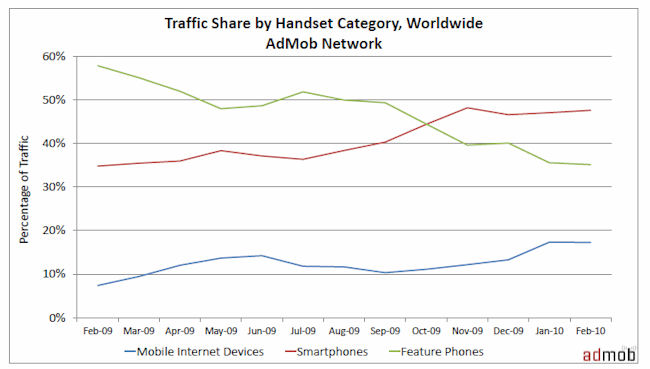
The majority (50%, up 7% yoy) of AdMob's requests come from the USA, which results in a geographic bias in the global numbers (and is also Symbian weakest market). AdMob provides an SDK to Android and iPhone developers allowing them to include AdMob powered adverts in their applications, which has been an important growth area for AdMob in the last 12 months and will clearly give a bias towards these two platforms. As noted by AdMob's themselves the increased proportion of smartphones (from 35% to 42%) is 'fuelled by heavy application use of iPhone and Android' devices.
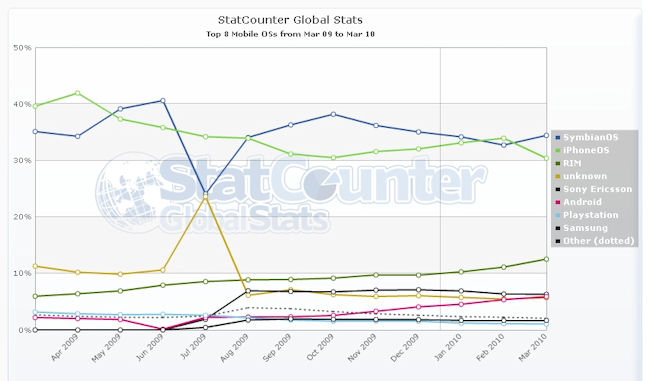
Getting reliable statistics about the mobile web is difficult. Methodologies tend to vary greatly and there is difficulty in obtaining a representative data sample that can accurately identify all the different devices and platfroms concerned. StatCounter (shown below) offer a viewpoint based on the aggregation of their metrics service.
What AdMob's stats do clearly show is an increasing number of ad requests to AdMob, from 6.5 billion in February 2009 to 14.1 billion in February 2010. While some of that growth is attributable to AdMob's growth as a company over the last year, it is also indicative of a healthy and rapidly growing market for mobile advertising both on web sites and inside applications.
They may also suggest that the Symbian application ecosystem, in terms of advertising supported content, is behind Android and iPhone. Symbian, Nokia and Sony Ericsson all need to work to address this. However, given the continued market dominance of Symbian, it also suggests that there is an opportunity for an advertising network company to provide an easy to use in-app enablement system for Symbian developers.
Disclosure: All About Symbian uses AdMob on its mobile site.
News Discussion
Unregistered
NIce article Rafe, but your constant claim of Nokia's market dominance is misleading. Yes they dominate but look at the crappy low end phones that they proliferate globally. If Nokia competed solely in the Smartphone (S60) arena, it would be quite different. Especially with the N97 quality debacle. Yes, they put out more phones than anyone else and it is only natural to have a market dominance when you flood the market with phones.
Unregistered
@unregistered:
Methinks you do protest too much. If ever I saw a comment posted by a stung iPhone or Android user trying desperately to justify their choice of platform against their and the platform's insecurities, that was it.
> but your constant claim of Nokia's market dominance is misleading
Not really. Even you agree with it, twice :)
Why on earth do you call them crappy? Crappy by what metric? Crappy because you spent hard earned cash on an N97 and it didn't live up to your expectations? Like so many who slag off Nokia blindly, you're just hitting out because you got hurt. Nokia's global numbers prove that not only does it not make crappy phones, but it makes phones VASTLY better than the competition. Price can be included in 'better' and it's that that offers millions of people the chance of a smartphone at all, and one superior in many ways to anything else out there (cameras, OS, robustness, and so on), compared to a world where only feature-poor and implementation poor (dropped calls, underpowered immature OS, crap camera, lame battery life - all rife throughout all iPhone and Android models on the market).
Rafe
I'd be the first one to say you define leadership / market dominance in a number of ways, but that goes both ways. And I think doing the global eveything approach is probably the on that's easiest to look at.
Nokia has quite deliberately had a strategy of high segmentation (flooding the market with lots of different phones) because it has been commericially sucessful for them. The signs are that this is changing - look at the Mobile Computer - Smartphone - Mobile Phone three tier strategy for this...
Better is in the eye of the beholder too as the commenter above mentions.
I've said many times that Nokia faces formidable competition in the high end, but the tendency for some people to write Nokia off over the last years does not make much sense to me. It is a bit short-termist (especially given Nokia's history and tendency to move lik an oil tanker) and tends to be looking through tightly defined vision (either geographically or by defintion).
What I wanted to point out with this article is the AdMob stats provide a very useful snapshot of their business and you can look at some interesting trends, but they need to be considered in context. I didn't really mean to get into another 'platform x is better' discussion.
Mr Mark
Quote:
|
If Nokia competed solely in the Smartphone (S60) arena, it would be quite different.
|
Well no, it wouldn't. Not if you go by Gartner, IDC and Canalsys' metrics. Nokia still has a commanding lead and increased share last year.
telenow_net
Google breaks AdMob even by 2014; makes a $6B killing by 2020 says a TeleNow.net report. Link to the full report and analysis:
http://bit.ly/bExsCL
This is particularly interesting in light of FCC issues with the acquisitions
Full thread: 5 Comments / Post New Comment