
How to: Remove scratches from your phone's camera 'glass'
Published by Steve Litchfield at 9:29 UTC, May 1st 2009
This applies to any phone with exposed camera 'glass', i.e. which has no physical, protective shutter.
You'll remember from last year that, through over-zealous attempts to wipe off dust, the camera 'glass' (actually plastic) on my Nokia N95 8GB had actually gotten more damaged than if I'd left the dust on (I suspect). Despite normally being kept immaculate in a case, after three months of use, this is how the camera cover looked:
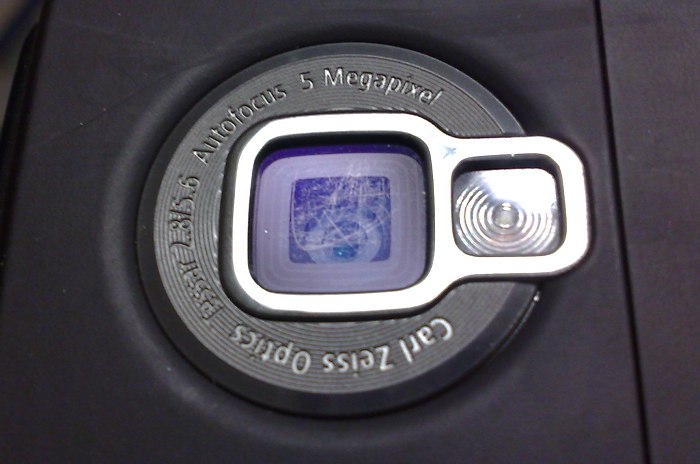
Although I proved that this had little effect on most photos, it was still galling to have damaged this most important part of my phone.
However, the scratches concerned were tiny and I had the gut feel that they could be polished out easily enough. 'Polishing' here is taken to mean very lightly abrading the surface to bring the level of the top surface of the transparent plastic down to so that the scratches (i.e. the tiny, shallow grooves where dust particles have gouged in) become part of the surface, restoring a nice, clean and smooth cover that doesn't mess with the light coming into the main (glass) optics of the camera below.
But what to polish with? Screen cleaner? No, that would just add a layer of polymers over the top of the scratches. Toothpaste? That's been said to do the trick, but there are so many varieties - do I use 'Whitening' paste? Following a recommendation on Twitter, I bought some 'Displex' on eBay. Costing £3, including postage, this claims to both polish out small scratches and (if necessary) fill in any deeper ones in a useable way.
Displex comes as a small tube of creamy liquid (enough for about 1000 applications!) and a lint-free cloth:

Now to work:
- I followed the Displex advice to mask off the surrounding plastic with tape, just in case.
- Adding a couple of drops to the camera 'glass', I firmly rubbed the Displex in with the cloth, using a circular motion, for about 30 seconds.
- Almost all the scratches were, somewhat magically, gone. I repeated the treatment with another couple of drops and another 30 secs polishing.
Here's the result:

Rather impressive, I think you'll agree. The virgin phone did, apparently, have an extra, anti-glare coating applied to the 'glass', and the polishing action has removed most of this, but I've noticed no difference in terms of photo quality.
As ever with this sort of tutorial/feature, I'm eager to gather data points. Have you tried something similar with one of your camera phones, and if so, what were your experiences?
Steve Litchfield, All About Symbian, 1 May 2009
Categories: How To, Hardware
Platforms: General
Feature Discussion
mCrem
Wow very helpful indeed.. I might get some and keep it in handy.. Would said method also work on glossy surfaces (Say, Samsung omniaHD backplate) or glass on a wrist watch?
Unregistered
No.. it works by polishing some of the material off - therefore it must be a relatively soft material i.e. the plastic screen from N95
Unregistered
Can this be used for the screen of the N96
Arcade
I dont know. You are removing matter from your lens. Sounds like a big thing to me...
Unregistered
Steve your N95 lens were never scratched, it's the antiglare layer that's scratch and coming off. I had the same problem as you when I got my N95 and thought I scratched it, but after rubbing the lends with my bare finger for a few minutes I realize the "glass" was never scratched but the protective antiglare layer was coming off.
Displex is actually bad for many types of lens, I would advise you to update the post to tell people to try displex on a small surface of a similar material before putting it directly on their mobile device.
I tried using displex on a ipod before and what it does is it will grind your product and add a thin layer of polish to it. It will look new, but if you take a piece of cloth used for eye glass and wipe of the polish you will see a lot more tiny scratches on it.
Seriously, DONT USE DISPLEX!!!
If you have to use it, try it on a surface of a similar material to make sure it does work.
slitchfield
Thanks for the warning. I agree that a polishing agent like this shouldn't be used on a *lens*. But we're talking about a dumb piece of covering plastic here.
And I also agree about the common sense technique for trying a small portion before tackling a larger surface.
Still, at least we know that Displex cuts off a scratched anti-glare coating! 8-)
UKJeeper
I've had reasonable success with Brasso (UK) and Duraglit (US) with removing light scratches from various PSP's and phone screens. Disclaimer: test on a small section of the screen first!
snoyt
There is stuff to fix scratches in CD's. That might be a better bet for fixing plastic optical surfaces.
Another option is anything that is used to polish real lenses. Choose one of the many cerium-oxide-based polishing agents such as like Vitrox C or Rhodite 15. According to the wikipedia
Brasso can also be used to polish out scratches in plastics:
* It is used to polish CDs, DVDs, screens, and pools in order to repair scratches. It is a mild solvent and an extremely fine abrasive, so when applied to the reflective surface of the disc and rubbed radially (in straight lines between the edge and center), it can smooth scratches and reduce their effect.[3][4] [5]
* Brasso can also be used on Lego minifigures to remove markings.[6]
* Brasso has also been used by watch enthusiasts to polish scratches out of acrylic crystals on watches.
If have seen Brasso being used to 'fix' (remove) the damaged AR-coating of a optical lens.
In any case, safe the tube of Displex. It might be handy for fixing the front of the N82, with it being plastic, it scratches pretty quick.
snoyt
wampyre
I see you followed my little tip there :)
Anyway as some of the comments states Displex should not be used with glass.
When it comes to the plastic covers such as N95 8gb and N96 it's more than decent to use a bit of it and start polishing. Even small scrathes will be fixed if you manage to polish the 'fluid' inside.
Personally I've only had experience with the plastic of screens and lenses such as on the 6600, N73 and N95 all in which was quite perfectly polished. One of the tricks is simply not to use too much force as the Displex I believe contains something that might scratch up things further if you apply too much force.
(Compare that to waxing a car with polish manually and you know what I mean)
As for lenses such as on the N82 I've yet to see some wonder product that will fix scratches on such lenses.
9 Comments / Post New Comment