
Nokia versus Apple and those 'surprising' stats - it's a question of range
Published by Steve Litchfield at 8:54 GMT, January 30th 2010
We live in interesting times. Nokia and Symbian (in particular) are regularly savaged in the tech press, yet managed to turn in (on Thursday) a surprisingly positive set of results, with over a billion Euros profit in Q4 2009 and with their smartphone market share up (not down, as the analysts would have you believe) 5%, worldwide. Read on for my thoughts on how Nokia has managed this particular feat and on why Symbian's market share is also not going away anytime soon - it's all a question of RANGE.

I don't pretend to have Rafe's encyclopaedic knowledge of the industry (here's his summary of the results) but I can spot a worldwide trend as well as the next (non-American) unbiased observer. It has been downright annoying over the last year or so hearing podcaster after blogger after analyst from North America all proclaiming that Symbian is dead, that Nokia is dying, and that Apple (and to a lesser extent Android and RIM) is the future, a runaway success.
Now, don't get me wrong, I love Apple too - I own two Macs and numerous iPods and other white accessories(!) - and yes, the iPhone is a lovely piece of engineering that is rightly enjoying huge success across the world. I have no problem with that at all. I also have no problem with RIM and their Blackberrys, the Bold 9700 is a stunning device and their messaging services continue to win fans. Ditto Android, the new OS on the block, which shows great potential and I don't doubt that it'll be a major player over the next few years.
But Symbian dead? Cough. I don't think so. Even in its darkest period (also known as 2009, while the entire OS had to be checked for licensing and overhauled in a multi-stage process), it seems that sales of Symbian-powered smartphones have remained steady, at worst and risen, at best.
The much-talked about push of Symbian down towards lower-priced phones, seen by some rather snobbishly, can surely only be a good thing, both for users, who get their hands on a fully multitasking, fully functioning smartphone for a lot less money than before, and for the Symbian Foundation, whose OS gets into far more people's hands.
Far more hands equals higher overall sales numbers and potentially higher market share, though we do have to take into account the growth of the smartphone segment overall and the growth of Nokia and Symbian's competitors. In any case, I wouldn't expect Symbian's current worldwide smartphone marketshare of 45% to be dented too significantly, despite the onslaught of competition - and it's even possible that market share will rise.
All of which will utterly confound the North American press, for whom Nokia and Symbian are a complete enigma. Listening to the American podcasters (e.g. Cranky Geeks, here), I've heard them try to rationalise things by:
- splitting 'smartphones' into 'real' smartphones (devices with large touchscreens and widely stocked app stores - they're thinking iPhones and Droids, and so forth here) and 'almost feature phone' 'not-quite-so-smart' phones (meaning Symbian phones)
- taking things further by inventing a whole new class of phone, the 'app-phone'. The assumption here is that Symbian-powered phones can't really run add-on applications. Aside from high performance games, most of us would dispute this claim, I suspect. Symbian-powered (and before 2000, EPOC-powered) phones, communicators and palmtops have been running add-on applications since 1993, a full decade before the iPhone was a gleam in Steve Jobs' eye and Android was a gleam in Andy Rubin's
I can understand their frustration, I really can. The American market is so dominated by carriers and by heavily-subsidised, contract handsets. In this sort of environment, an expensive iPhone 3GS (for example) is easily disguised in a $70 a month, two year plan, whereas Nokia phones have to be bought up front and a voice/data plan then added from the aforementioned exorbitantly priced carriers. In the rest of the world, we've both got Nokia and Symbian-powered phones readily available on cheaper contracts from all carriers in almost all countries, plus it's also often practical to buy them without a contract and then simply use a pay-as-you-go SIM.
I can also understand the desire to split the market up into two distinct segments: large-screened, touch-driven phones (where the iPhone can dominate, stats-wise) and smaller-screened, usually button-driven phones (where Nokia can 'safely' be pigeon-holed and allowed to dominate, without risk of embarrassing the likes of Apple and Google). In fact, in an upcoming Phones Show, I'm going to split my usual 'Top 5' celebration into two Top 5s - for touch and non-touch, for each have their own pros and cons and it is rather artificial to compare the stats for, say, an iPhone 3GS and a Nokia E63 - utterly different form factors at different prices for different markets.
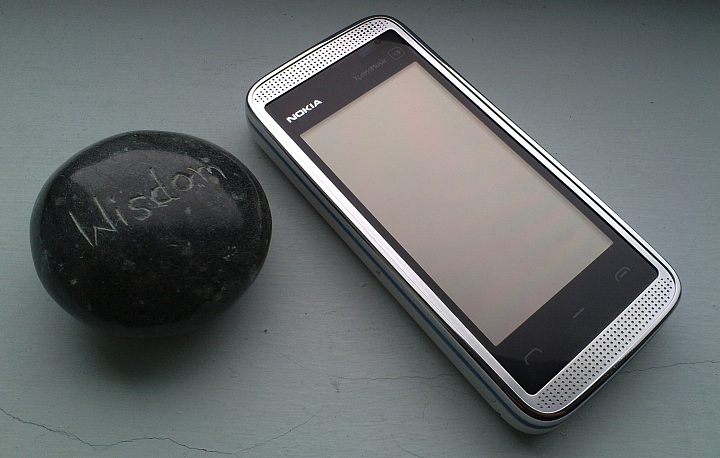
However, things aren't as clear cut as that. Phones like Nokia's 5530 XpressMusic, a candybar, full-face touchscreen smartphone with (nearly) ubiquitous kinetic scrolling and all the usual apps, including the much-improved Nokia Ovi Store (for apps), all for £130 or less, confound the above reasoning. The 5530 is quite clearly inferior to the iPhone 3GS in several ways (though also superior in a few, too), yet it's something like a quarter the price.
Which is where I came in. Nokia's strength in the smartphone world is its range. Firstly, in terms of number of devices (we'll leave the argument that they've produced too many designs for another day!), from £100 (all prices in this article are contract-free, by the way, so that I can compare like with like, etc) button-driven candybars, through touchscreen and qwerty-driven candybars, to mid range messaging smartphones, to media-centric touchscreen tablets, to high end imaging phones and touch/qwerty hybrids at £450 at most.
£100 to £450 - that's quite a range. In contrast, Apple's iPhones start (contract-free) at £340, for their lowliest 3G model, up to £560 for the highest-spec 3GS unit. Looking at these ranges on a chart, it's apparent that the overlap between Nokia and Apple, in terms of market positioning, is relatively small. I've also added in RIM, for interest-sake.

Secondly, there's geographical 'range' to think about. Most phone manufacturers have made an effort on most continents (with the notable exception of Nokia in the USA, somewhat ironically and paradoxically!), but Nokia has the largest distribution network of all and is a reliable, prestige, top-end phone brand in countries which haven't even seen an iPhone or Android-powered phone yet.
And it's these countries which are increasingly adding to the worldwide sales figures and to market share calculations.
Does all this mean that Nokia and Symbian are going to rule the world? Maybe, but that would be a very blinkered view. What it does mean is that Nokia's range overall, and their range in smartphones specifically, gives it a real edge in terms of getting powerful, extensible phones out to more people on more budgets than its competitors.
A final thought is that sales of 'smartphones' ('Converged devices', in Canalys speak) are still only about 20% of the overall phone market. (This has historically been limited by pricing issues, but with Symbian becoming ever more accessible in ever cheaper phones, this figure will surely rise.) Leaving a huge growth for smartphones of all sizes, prices, form factors and persuasions. Apple's and RIM's and Nokia's and Samsung's (and so on) smartphone sales could all double without significantly affecting each others bottom lines - the take-up could all be from within the traditional 'feature phone' pool of buyers.
This is still a marketplace that has a lot of growing to do.
Steve Litchfield, All About Symbian, 30th January 2010
Categories: Miscellaneous, Industry, Editorial Thoughts
Platforms: General, S60 3rd Edition, S60 5th Edition
News Discussion
Hung Yih
Wow, a holistic analysis Steve. Well done! =)
rexdude
..and spot on.
It frustrates me no end that the tech news/blogging space is utterly dominated by clueless American bloggers and journalists. These people are the ones who have never seen a smartphone before 2007 and think that America is the world when it comes to smartphone markets.
Personally, I detest the control freak nature of Apple that manifests itself in all its products, not to mention I've been using Nokia since 2004, and been able to do much more than any iPhone for a long time.
tomsky
I'd like to add something to the analysis: geographic range.
Nokia is very prolific in developing countries and outside of the North-America/Western-Europe market. American companies like Apple tend to find it harder to make money in these markets because they tend to be larger volume, lower price markets, and their model is based upon high-end models not quite out of the reach of the masses, making lots of money from a small range of products.
Tenkom
My n95 8gb can run quake3. I consider that high power. My i8910 can run it at 640x360 resolution with max detail with decent framerates.
Unregistered
Well done Steve, this is reality, Nokia is and will keep on the phone market as the world leader.
I've read some iPhone articles claiming that "Now" they can do VOIP, and I don't remember since when Nokia handset can do this.
jasonpich
Unregistered
I think the definitions should change - no phone with 320x240 screen resolution deserves to be called "smartphone" in 2010. This is low end, ugly, practically unusable for web browsing. How is that smart? Nokia E60 form 2005 had 352 x 416 resolution!
GJW
People tend to underestimate Nokia. I really was surprised to read that the Finns became the #1 seller of touch phones. Almost overnight, almost sneaking, very few pundits predicted it and... bang!
It's uncanny.
Unregistered
Quote:
Originally Posted by GJW
People tend to underestimate Nokia. I really was surprised to read that the Finns became the #1 seller of touch phones. Almost overnight, almost sneaking, very few pundits predicted it and... bang!
It's uncanny.
|
Absolutely fantastic, if you are interested in finance and markets shares. Not so much for a geek like me, who wants top, high end, fast modern phone with lots of memory, fast processor and nice UI...
Unregistered
unregistered wrote:
"I think the definitions should change - no phone with 320x240 screen resolution deserves to be called "smartphone" in 2010. This is low end, ugly, practically unusable for web browsing. How is that smart? Nokia E60 form 2005 had 352 x 416 resolution!"
Full browsing like iphone right ? With java and flash support ? Come on!!
Unregistered
2010, not 2009 on your signature at the end of the article =)
davidmaxwaterma
That photo of the 5530 reminds me how it bugs me that the speakers on all smart phones point away from the user. The 5530 looks like it has them facing the user, but it actually doesn't...why? why? why? How long before they realise the user is in front of the screen and so the speakers should point that way? Having them point in some other direction makes the treble and mid-range sound aweful. They could at least put a tweater in the front - they don't take much space.
The E90 even had them facing *backwards*!
Sigh.
/me wishing for speakers integrated with screen (perhaps having a woofer in the back).
Unregistered
@davidmaxwaterma
What?!
The 5530 HAS the speakers pointing at the user - what are you smoking? (Psst, pass the pipe.)
KPOM
I don't think it is "rationalizing" to divide the smartphone market into segments. Technology progresses, and what was a "smartphone" in 2002 is essentially a feature phone now. The fact of the matter is that Nokia will be a major seller of mobile phones for the foreseeable future and no one is disputing that. They are extremely efficient and can produce phones at a lower cost than anyone else. That means they will definitely benefit from sales in emerging markets.
The questions, though, are whether they will be limited to selling a commodity, and whether they will be able to leverage their large hardware market share to develop their software-oriented businesses. Those are real questions given the competition.
For all the talk about how "irrelevant" the North American market is, it is interesting that North American companies are the ones generating not only press interest but also increasing revenue and profits. Those companies are a real threat to Nokia's dominance of the most profitable ranges of the market. The profitable segment was once almost synonymous with the smartphone segment, but as the smartphone range is pushed lower and lower, it no longer is. It does make a difference where in the "range" Nokia's sales come from. Last quarter was an encouraging sign, with the average selling price creeping up, but it is still a question whether they can sustain it. It is interesting, though, that from the chart it appears Nokia doesn't even try to compete at the upper price ranges where Apple and RIM do.
In services, too, Nokia is struggling. They realize it is the way forward. Look how much time and money they spent trying, unsuccessfully to build N-Gage. Apple comes along with its SDK and suddenly has the most popular portable gaming devices in the iPod Touch and iPhone. There's a potential market lost.
As for the "app-phone" it was largely the anti-iPhone crowd who created this distinction back in 2007. One of the criticisms back then was that iPhone wasn't really a "smartphone" because it didn't have third party applications. Now that it utterly dominates the third party application market, I find it interesting how suddenly that tone has changed. For all the talk of the "improved" Ovi Store, it also should be pointed out that Ovi Maps, which was once hoped to be a source of significant software revenue from navigation and POI guides, has been repositioned as a bundled service (i.e. zero marginal revenue) to generate hardware sales. Again, it is an opportunity lost.
The bottom line is that while reports of Nokia's demise are clearly exaggerated, so are reports that all is well in Espoo.
davidmaxwaterma
Quote:
Originally Posted by Unregistered
@davidmaxwaterma
What?!
The 5530 HAS the speakers pointing at the user - what are you smoking? (Psst, pass the pipe.)
|
Well, I could be wrong, if course, but I took a really close look at it and those grills on either side of the screen didn't actually have speakers underneath them[1]. If you have one and know this to not be true, I'd be happy to be wrong :)
[1] of course, one of them has the phone's speaker under it
Unregistered
Apple doesn't care about market share--they care about revenue share. They're ignoring the low-end on purpose to grab the profits.
daos
In my opinion smartphone is one, which has possibility to install 3rd party applications, period. So even those "feature" phones, which can run java applications are smartphones, regardless size of display, time of production, touch or not touchscreen.
Unregistered
I live in the UK big android fan. I agree the Steve, North American bias. I watching Meamo closely was going to buy a N900 but was frustrated by Nokia delays but now I thnk I might wait for the second generation device. I just bought the Nexus One and its very impressive.
I had a lot of symbian devices over the years and would still buy one if they made a device that had the what I wanted.
I hope and pray symbian and Meamo go from strength to strengh we need competion to drive the envelope.... iphone in my opinion will slip as US catch on to android which knocks spots off iphone.
rlaskey
I'm an American, and I'm a geek; and I couldn't agree with you more. I've had a Nokia 5800 for a bit less than a year, and it constantly blows me away at how much more useful it is, and at a price so much less than other popular options.
I don't watch TV much at all, but the amount of advertising for the iPhone, and, now, Android, is rather extreme. Nokia, comparatively, is nowhere to be seen. I'm personally OK with this, as I think everyone is a bit flooded with adverts regardless of the genre; though it certainly does infiltrate the consciousness of the population who go out and buy mobile devices.
The second trouble in the US is the trouble between Nokia and the US carriers. Verizon firmwares are very much standardized, tending towards Verizon services; and likewise for AT&T and the others. They're developing their brand heavily, infusing it into the devices that are subsidized. In a sense, it's a constant advert for the device itself.
However, with the advent of the iPhone, along with its AT&T exclusivity, there are now subtle breaks from this pattern: iPhone implies AT&T, and so boosting the iPhone brand also boosts AT&T. Android is similarly a bit more independent, and the red markings are aligned with Verizon's brand go hand in hand. The "droid does" campaign boosts not just Android, but Verizon, since it's exclusive to this carrier. Of course, the only way that either of these cases work is with a massive amount of advertising in the devices themselves; again, something that Nokia does not exert in anywhere near the same force.
Personally, I find this all to be a good thing, for me; I don't particularly like the saturation of advertising, and part of the value of the Nokia brand is that it isn't being shoved down my throat. I picked up my 5800 for $260 after rebate, unlocked, with no carrier obligations. My data plan is half the rate of other branded, carrier-subsidized devices. Now, especially with Ovi Maps for free, it's just an insane amount of value, well above anything that's offered in the USA otherwise. A friend of mine has a Droid (Motorola Milestone), and, sure, it's a nice device; but I get more battery life out of my 5800, and there's really nothing that I feel is lacking from his general mobile experience to mine.
The sad end result is that marketing works. Even so, the worst part is that, as Steve mentions, the American tech journalists continually forget about financial restraints. They most all seem to be caught up by a cohesive mega-cool bubble which ought not be popped by an average person's income. I find it very irresponsible on their part, especially when there are so many people without jobs or money or both. That's not to say that there aren't a lot of wonderful devices out there; but that _especially_ in these financial times, the lower end of the graph deserves more attention, not less. At the end of the day, it's about access, not image, and I appreciate your continued fight towards that end.
Unregistered
I see many people defining it in terms of various hardware terms, someone mentioned screen size above ...
For me, the important thing is the software. A smart phone is Smart, that is, able to learn new things, or less anthropomorphically, is programmable using an API available to the public, so people can "teach it new stuff", that is, run 3rd party apps.
A device, no matter how fancy the hardware (big screen, QWERTY keyboard), but without an OS that allows 3rd part apps is at best an idiot savant, not Smart.
IvanDM
I think when someone says "Symbian is dead/dying", it's referring to Symbian Foundation. There are NO PHONES being shipped today (and in the past year) based on anything done within (or from) the Foundation. Correct me if I'm wrong, but if there are I didn't see it.
S60, on the other hand, is something that is taking it's own way. After all, it as always been like that: majority of the S60 technologies is Nokia's, not Symbian developed. And anyone says "it's not true", either never worked for Symbian or simply is lying.
So, S60 yes is still making most of the money that keeps Nokia on the top. And it's Nokia, after all, developing what is going to be the next S60, the one supposed to act and look "competitive".
Nokia, after Symbian^4, is going to abandon the support is giving them: if by then it doesn't manage to live on it's own, Symbian will be dead.
And, that's my personal and cynic opinion, "who says that this wasn't the plan since day 1 of the Nokia's acquisition?" Am I crazy? Possibly. I still can't see Nokia as an Open Source give away-er: Maemo still doesn't arouse me in this direction.
Unregistered
@IvanDM
The Symbian Foundation is just a rename/restructure of Symbian Limited, whiich contributed the underlying OS to ALL Symbian phones. It is currently going through a project to turn Symbian OS to Open Source.
The S60 UI which Nokia developed and is now open source and contributed to the Symbian Foundation Symbian open source project.
S60 was developed as, and worked very well as a keypad driven, isn't as trim and lightweight as Symbian OS.
The S60 classes Avkon Library is being replaced by Orbit, QT being the programming environment, this will simplify things. There is also DirectUI as the UI logic to be implemented.
N97 mini appears to be a Symbian ^2 phone, closest I can find to fit the description. There are no Symbian ^3 yet.
Unregistered
Quote:
Originally Posted by Unregistered
@IvanDM
The Symbian Foundation is just a rename/restructure of Symbian Limited, whiich contributed the underlying OS to ALL Symbian phones. It is currently going through a project to turn Symbian OS to Open Source.
|
symbian foundation is not symbian limited restructured they are two totally different entities although i can see how your confused as the courts had hard time getting there head round it when nokia handed some of the acquisitions they got from buying symbian limited to the foundation.
nokia purchased symbian limited then founded symbian foundation which is a non-profit organisation where as symbian limited was a commercial operation to make money.
Unregistered
Quote:
Originally Posted by Unregistered
symbian foundation is not symbian limited restructured they are two totally different entities although i can see how your confused as the courts had hard time getting there head round it when nokia handed some of the acquisitions they got from buying symbian limited to the foundation.
nokia purchased symbian limited then founded symbian foundation which is a non-profit organisation where as symbian limited was a commercial operation to make money.
|
Forget the pedantic legal detail, in practical terms one begat the other. Symbian Limited, 1 Boundary Row, Southwark now doesn't exist and transferred operations to Symbian Foundation, 1 Boundary Row, Southwark after Nokia became the sole owner.
Regardless of what is a standalone entity and what isn't, it all amounts to the same thing. If the business structure changed from commercial to non profit, then to all intents and purposes, that is a restructure.
Dead1nside
The iPhone in its various incarnations makes it a bit easy to make assumptions about the phone market. Comparing the iPhone family's sales to say the N97 you'll clearly make the decision that almost like-for-like the iPhone is a runaway success; And just walking down the street will show you that the iPhone has sold a lot, and is popular. However, there's so many different types of customer and not all of them want to spend ~£500 off-contract to get an iPhone 3GS. There's a lot of people who are getting devices like the 5800 which is a stellar phone for multimedia consumption and definitely a smartphone and in many ways compares favourably with the iPhone when price is considered.
Even real-world users of iPhones come into contact with the problems of the device, limited multi-tasking and an inability to install whatever they want on the phone.
Thank God Nokia's turned a profit and increased marketshare, maybe people will remember that it's more than premature to say that the fight is lost. As you rightly say Nokia has a growing market in developing countries and is also pushing these smartphone features down to the lower price points. If anything Nokia needs to also regain the prestige of the N Series line and I think they're hoping to with a more consumer friendly, well-rounded Maemo OS on a new device. There was the graph of sales by series for Nokia devices on this website recently and numbered phones and E Series phones have risen whereas the N series has fallen.
I've got an N82 and it does as least as much, and excels in many regions when compared to Blackberries and the first iPhone.
What Nokia has _actually_ lost out in is mindshare, and that's an important crown to hold for an aspirational brand. I hope Nokia continues to make robust, proper devices but style is important too. Currently I think they've got it right in a number of devices like the 5800, N97 and N86 -- I think they're all stylish. My problem is that devices like the N97 don't offer anything in my opinion over my N82 and there's no reason to switch to one. Likewise I'm intrigued and want to own an N900 but it's just not there yet, even for a technically-minded person like myself.
Unregistered
Well balanced analysis, as usual, Steve!
With regards to The Cranky Geeks, they were just saying in an earlier podcast that Nokia is giving up Symbian, and switching over to Android!
I think the podcasters and reporters should have a wider view of things.
Just to give another perspective, I'm down in the tiny island of Singapore. I'm using an E71, on contract for 2 years. My monthly bill is US$24 and I get 100 minutes outgoing, totally free incoming, 500 free sms. Oh, and by the way, incoming and outgoing includes voice and video calls.
If I choose to upgrade now, (and I can soon, after 20 months into the contract -- which is how long I've been enjoying my E71!) I can get a Nokia N97 mini, with a new contract, at US$360. Oh, and I have a 3G data plan (up to 1G a month) at US$7.
Try getting this kind of prices in US....
Full thread: 35 Comments / Post New Comment